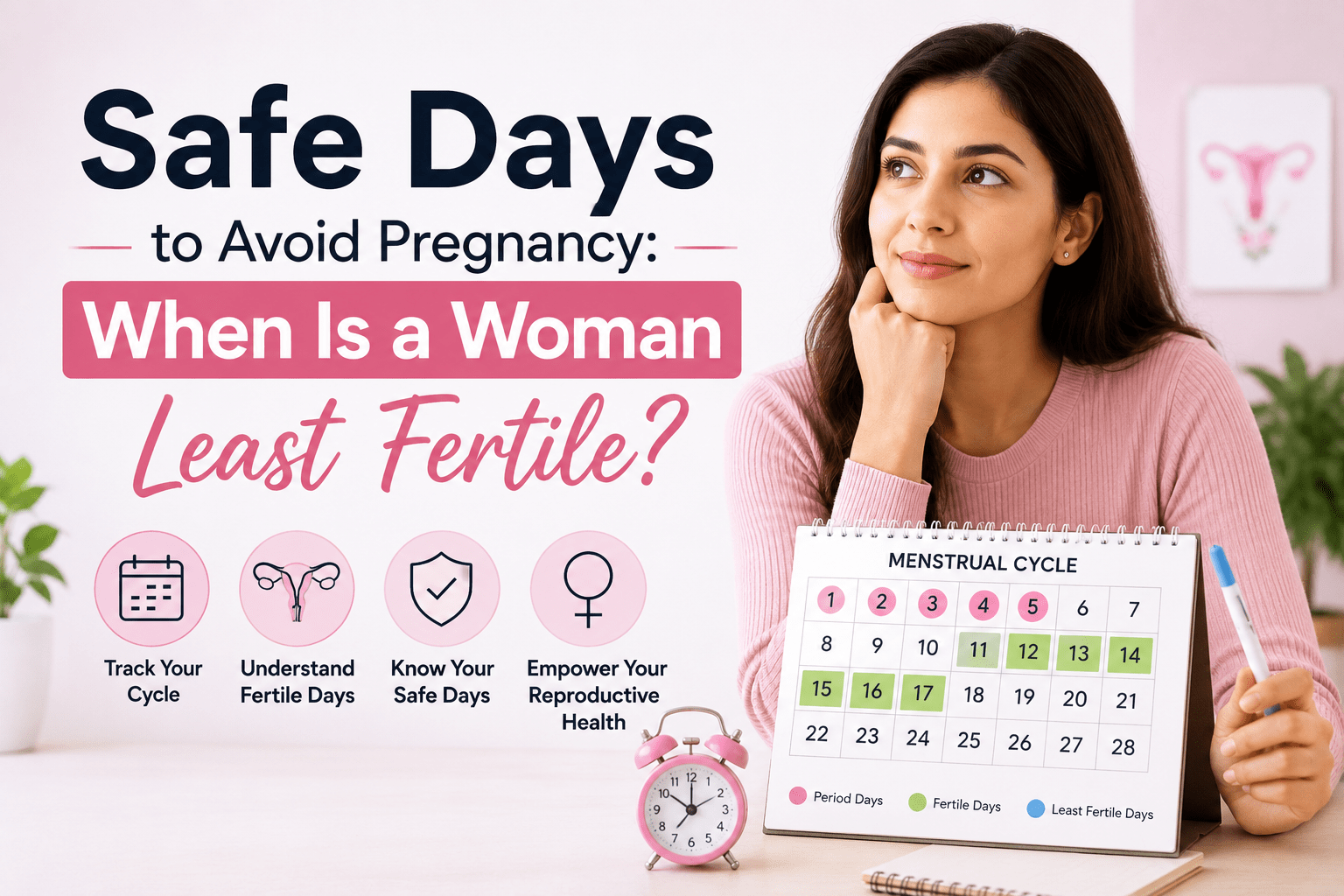
 So the question is when is a woman least fertile, many couples, especially women often ask these questions like when woman is least fertile, what is the safe period for sex, What are the safe days after periods?, so many women wonder about the safe days to avoid pregnancy even exists, so yes these days exist. And these topics are also searched worldwide.
So you firstly understand your menstrual cycle which will help you to identify the lower risk days for conception. Meanwhile you also have to understand that no natural method is 100% effective.
In this blog you will get information about the menstrual cycle, fertile and no-fertile days, and how to calculate the safe period/safe days to have sex more accurately.
So the question is when is a woman least fertile, many couples, especially women often ask these questions like when woman is least fertile, what is the safe period for sex, What are the safe days after periods?, so many women wonder about the safe days to avoid pregnancy even exists, so yes these days exist. And these topics are also searched worldwide.
So you firstly understand your menstrual cycle which will help you to identify the lower risk days for conception. Meanwhile you also have to understand that no natural method is 100% effective.
In this blog you will get information about the menstrual cycle, fertile and no-fertile days, and how to calculate the safe period/safe days to have sex more accurately.
Understanding the Menstrual Cycle
To understand fertility you first need to understand your menstrual cycle and how the menstrual cycle works. A typical menstrual cycle lasts between 21 days to 35 days and 28 days on average. During this cycle hormones prepare your body for pregnancy.The menstrual cycle consists of four phases:
Menstrual Phase
This is when bleeding occurs and marks the beginning of a new cycle.Follicular Phase
The body prepares an egg for release.Ovulation Phase
The ovary releases an egg, which is the most fertile time of the cycle.Luteal Phase
If fertilization does not occur, hormone levels drop, leading to the next menstrual period.When Is a Woman Least Fertile?
A woman is considered as least fertile just before her periods, in between the periods and just after periods. As well as after ovulation has passed. However the fertility also depends upon factors like:- Hormonal health
- Age
- Stress levels
- Cycle length
- Medical conditions such as PCOS
What Is the Safe Period for Sex?
So the safe period for sex during the menstrual cycle refers to when you can do unprotected sex and the chances of being pregnant is low. For those women with cycle of 28 days the level of fertility calculated as:| Cycle Day | Fertility Level |
| Day 1–7 | Lower fertility |
| Day 8–10 | Fertility increasing |
| Day 11–17 | Highest fertility |
| Day 18–28 | Lower fertility |
Safe Days of a Woman After Periods
Some women think pregnancy is impossible immediately after menstruation and ask for the safe days of a woman after periods because they don’t want pregnancy after unprotected sex. The pregnancy is still possible immediately after menstruation but the chances are lower so if:- Sperm survives in the reproductive tract for several days
- Ovulation happens earlier than expected
- The menstrual cycle is short
Safe Sex Days: How Are They Calculated?
The theory behind safe sex days totally depends upon identifying ovulation and avoiding unprotected intercourse during fertile days.So the calulation of fertile and no-fertile days:
Step 1: Track Your Menstrual Cycle
Keep track of your cycle for no less than six months, so you can figure out the average length of it. At the end, you should look back on that whole time, not just one or two months. If you really can, be consistent day-to-day, even if it seems a bit tedious.Step 2: Estimate Ovulation
Ovulation usually starts 14 days before your next menstrual cycle. For example: If your cycle is of 28 days then the ovulation will start on day 14. If your cycle is of 30 days then the ovulation will start on day 16.Step 3: Identify Fertile Days
Sperm survives for around 5 days or less in the female body and eggs survive for around 24 hours. Fertility extends beyond the day of ovulation. Most fertile days include:- Five days before ovulation
- Ovulation day
- One day after ovulation
What Is the Safe Period to Have Sex?
The safe period to have sex can be:- During menstruation
- A few days after periods end
- Several days after ovulation
Factors That Affect Fertility Timing
There are so many factors which affect your fertility like:- Stress
- Sudden Weight Changes
- Medications
- Change is routine
Is the Safe Period Method Effective?
The safe period method is also referred to as fertility awareness method, and has benefits and limitations. Benefits:- Helps women understand their reproductive health
- No medical intervention required
- Natural and hormone-free
- Difficult for women with irregular periods
- Less effective than contraceptive methods
- Does not protect against sexually transmitted infections (STIs)
- Ovulation may occur unexpectedly
Who Should Avoid Relying on Safe Days?
The safe day period to avoid pregnancy is not suitable for the women who:- Have irregular periods
- Have PCOS
- Are approaching menopause
- Have recently given birth
- Recently stopped hormonal birth control
Can You Get Pregnant During Your Period?
The uncommon/unwanted pregnancy is possible if you do unprotected sex during periods. Women who have shorter menstruation cycles ovulate soon after periods. Since sperm survive inside the reproductive tract for up to five days, conception can occur if ovulation happens earlier than expected.Best Ways to Track Fertility Naturally
To improve accuracy, many women combine:- Period tracking apps
- Ovulation predictor kits
- Basal body temperature monitoring
- Cervical mucus tracking